
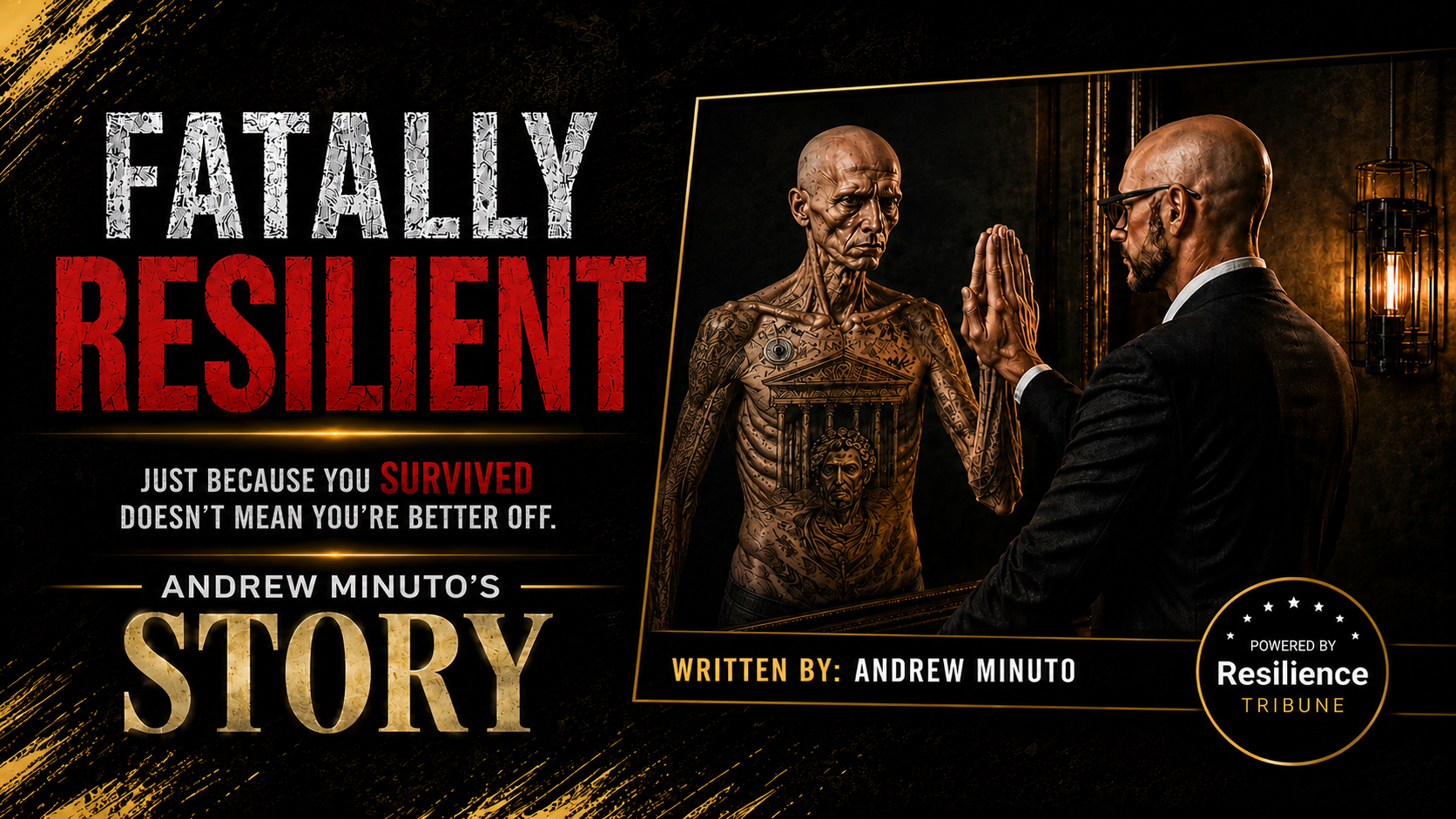

Written by: Andrew Minuto
Resilience
“The capacity to withstand or recover quickly from difficulties.”
The dictionary defines resilience this way.
Clean. Concise. Almost sterile.
What the dictionary fails to provide is any insight into the conditions under which resilience actually manifests. It offers no preview of the environments that create it, nor any warning for the psychological violence often required to sustain it.
I can only speak for myself, but resilient is never a word I would have used to describe myself growing up—or even throughout most of my twenties.
Resilience, for me, emerged through process of elimination.
You do not need resilience when you have parents willing to bail you out of adversity. You do not need it when siblings are willing to help you get back on your feet, or when a spouse still sees enough future value in you to protect the investment they made at the altar.
No—resilience, for me, was not taught.
It was not learned.
It was not inspirational.
It simply manifested, like a flame, under the most dire of conditions.

When the Safety Net Disappears
That time eventually came.
My parents had been dead for five years.
My siblings had moved across the country.
My wife no longer saw value in remaining by my side.
The safety net vanished.
And what remained was me.
Resilience became the product of one too many hard conversations with myself—the kind that end with the realization that there is no backup plan.
Nobody is coming to rescue you.
Nobody is coming to make this easier.
Nobody is arriving to interrupt the consequences of your own decisions.
Those conversations did not occur in the comfort of my own home or inside the welcoming environment of a therapist’s office.
They occurred while sleeping on the floor of a friend’s house because I was no longer welcome in the home I had built with my wife and for my daughter.
They occurred while detoxing from a plethora of illicit substances inside a community jail cell after being arrested for polysubstance DUI.
And perhaps most impactfully, they occurred while sitting in a treatment facility for the fourth time, 2,500 miles away from the only place I had ever called home, fully aware of the consequences waiting for me the moment I returned.
No—resilience is not glamorous.
It does not arrive with streamers and ribbons.
It first appears as a stark reminder of just how alone you are in a world far colder and darker than most people will ever have to comprehend.
Looking Inward
At thirty-one years old, something finally became clear to me.
No matter where you go, you bring yourself with you.
If the problem has followed you for years and is nobody’s fault but your own, then the problem is internal.
And if the problem is internal, the solution must also be internal.
The issue, however, is that the same mind which created and lived inside the problem for so long is often incapable of recognizing the solution—let alone creating it.
Sitting in that treatment center across the country, I contemplated the central contradiction of my life.
How could I be so emotionally dependent on others while simultaneously refusing to ask for or receive help?
Then came the questions.
- What if I let go of that?
- What if I asked for help becoming a better man?
- What if I received it?
- What if I became someone capable of acting in his own best interests?
- What if I stopped projecting strength to compensate for cowardice?
- What if I stopped taking the path of least resistance?
- What if I became someone my wife would regret leaving?
Challenge Accepted
For the first time in years, I felt something unfamiliar.
Hope.
I looked myself in the mirror and said:
“Challenge accepted.”
Through relentless introspection and self-assessment, I became that independent person.
Eventually, I would hear people describe their lifetime perception of me and barely recognize who they were talking about because that person no longer existed.
Transformation without trials is meaningless.
Character is easy to claim when life is cooperative.
The real test comes when the universe stops negotiating with you entirely.
Losing Everything
I returned home from treatment and immediately lost nearly everything.
- My career.
- My home.
- Custody of my daughter.
- My marriage.
- My vehicle.
- My virgin legal record.
And somehow, I took it in stride.
There is a famous Navy SEAL whose philosophy fundamentally reshaped the way I think.
Paraphrased:
On the other side of everything I fear stands a better version of myself. The only question is whether I am willing to endure the pain required to meet him.
Another author I admire once compared adversity to forging a sword.
Raw steel does not become a weapon through comfort.
It becomes one only after relentless heat and repeated blows.
The human mind is no different.
Mine bears innumerable scars as a result of that process.
Nevertheless, that mentality is precisely why I am alive.
Because adversity did not stop simply because I stopped making poor decisions.
Cancer
Just when I had finally begun rebuilding my life from the wreckage of addiction and self-destruction, I received a diagnosis of Stage III testicular cancer.
Family around?
None.
Sure, there were people willing to give rides here and there.
Maybe a meal if they felt inclined.
But not one person on this earth felt obligated to stand beside me through that battle.
Surviving cancer was an act of self-propulsion.
When it ended, I did not collapse.
I rebounded.
I worked twenty-two consecutive months without taking a single day off.
During that stretch, I earned three promotions and ultimately became Director of Operations.
My reward?
A second cancer diagnosis.
This one worse than the first.
What Resilience Actually Feels Like
People often romanticize resilience as some cinematic moment where a person courageously rises against adversity.
That is not what it feels like.
It feels:
- Exhausting.
- Unfair.
- Isolating.
Eventually, if endured long enough, it begins to alter your understanding of human nature itself.
I credit two people for being present during the darkest moments of that second battle.
Everything else was self-propulsion.
Waiting on the other side was not relief.
It was more loss.
- I lost my career.
- I lost my insurance.
- I had to rehome my cancer support dog.
- I lost my apartment and moved onto someone’s couch.

The Real Version
How did I survive all of that without losing my mind?
Resilience.
Not the motivational-poster version.
Not the social-media version.
The real version.
The understanding that nobody was going to fight those battles for me.
The realization that if my daughter was going to grow up with a present father, it would require everything I had left psychologically, emotionally, physically, and spiritually.
So that is exactly what I gave.
Even while much of the world around me sat idly by, watching my life deteriorate in real time.
The Final Lesson
Ironically, that is where resilience reveals its final lesson.
It is not always loud.
Sometimes resilience is simply waking up another day in circumstances that would have broken the previous version of yourself.
Sometimes it is surviving long enough to meet the person adversity was attempting to create all along.
By the time you finally possess resilience, you would give almost anything to no longer need it.


