
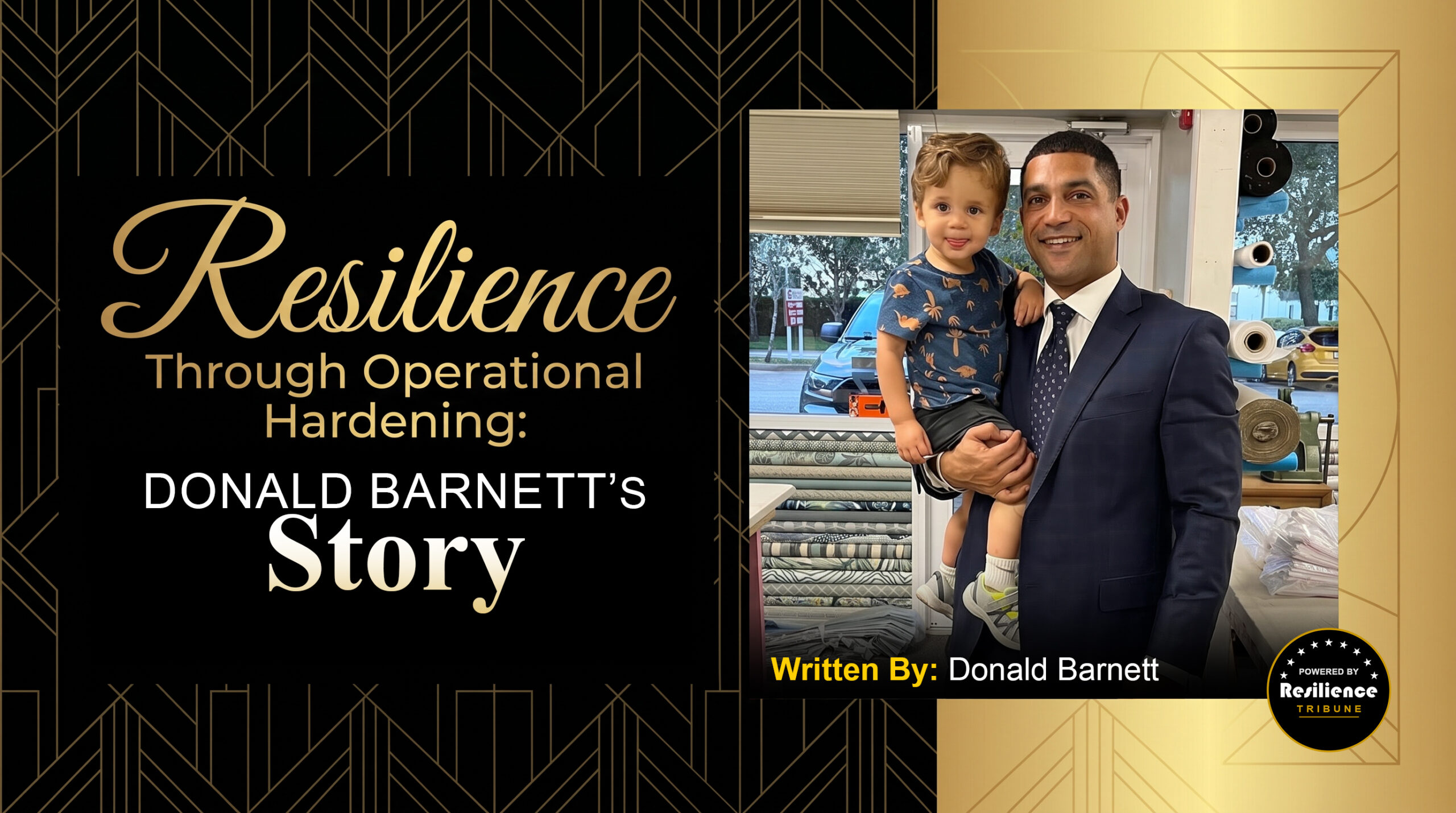

By Donald E. Barnett Jr., as told for The Resilience Tribune
“Get a Plant” — Where My Understanding of Resilience Began
If I could tell anyone where resilience starts, I wouldn’t begin with war stories, leadership seminars, or motivational speeches. I’d tell them to get a plant.
Love it. Talk to it. Make it yours.
Find something living that depends on consistency. Name it. Decorate around it. Give it a home. Because resilience often begins in the smallest forms of responsibility — in learning how to care for something before you fully learn how to care for yourself.
That may sound simple, but resilience rarely arrives through dramatic moments. It grows quietly through repetition, patience, discomfort, and discipline. It is change through experience. It is something many people speak about, but few truly understand until life forces them to.
I’ve learned that resilience is less of a science and more of an art. You can explain parts of it, but the real thing has to be lived.
Toughness Is Not the Same as Resilience
I’m a veteran. I grew up athletic, always a jock, surrounded by men who believed toughness was everything. We were knuckleheads in many ways — always trying to prove something, always measuring strength in volume, aggression, or bravado.
For years, I thought toughness and resilience were the same thing. They are not.
It wasn’t until my mid-to-late twenties that I began to understand how powerful a comfort zone can be. Many people never signed up to be hardened by life. They never asked to become strong, impactful, or battle-tested. So when you ask someone to become resilient, it has to be done with grace.
That is leadership.
Leadership is not screaming at people to be stronger. It is understanding where they are, then helping guide them somewhere better.
The Hidden Power of Positive Escape

One of the greatest lessons I’ve learned is that resilience requires healthy detachment
For me, I fish. Recently, I’ve taken up painting. I wouldn’t call myself a painter, but that doesn’t matter. The point is not mastery. The point is release.
People underestimate hobbies. They think outlets are luxuries when, in reality, they are survival tools. Healthy hobbies create the space needed to sustain long-term productivity, mental clarity, and emotional control.
I know people who have gone 40 or 50 years without a positive outlet. They live in environments where stress is normalized, where dysfunction is familiar, where comfort zones are prisons disguised as safety.
And when you live like that long enough, you start convincing yourself that merely surviving is the same thing as resilience.
It isn’t.
My Own Contradiction
My story is no different.
For the better part of three decades, I called myself tough. I chased challenge. I sought edges. I tested limits. Yet somewhere in that pursuit, I found myself becoming something deeper than tough. I became happy. I became grounded. I became resilient.
And if I’m honest, I still don’t fully understand how it happened.
Maybe I’m not supposed to.
Some truths are meant to be experienced more than explained. Resilience is one of them. It is contradiction in motion — strength with restraint, confidence with humility, discipline with softness.
Like wisdom, it cannot be rushed. Believe me, I tried.
When Art Meets Structure: My Formula for Resilience

While personal resilience is an art, professional resilience requires systems.
That’s where I developed what I call Operational Hardening — a framework for sustaining performance under pressure in both business and life. It is my attempt to take the abstract lessons of resilience and make them practical.
The formula is:
OH=(IF+SC)×AMFL+FMOH=FL+FM(IF+SC)×AM
What It Means
Intelligence Fusion (IF)
The ability to take chaos, confusion, and uncertainty — then refine it into truth and action.
System Compression (SC)
Removing waste, delay, excuses, and unnecessary friction between problem and solution.
Accountability Modifier (AM)
The multiplier. Talent means little without follow-through. Finishing what you start matters.
Friction Loss (FL)
The energy leaks: exhaustion, indecision, distractions, bad habits.
Friction Margin (FM)
The unseen obstacles life throws into every plan.
Measuring Your Current State
I often tell people to score each category honestly from 1 to 10 based on where they are now — not where they wish they were.
0–25: Fragile — relying on raw toughness alone.
26–50: Functional — systems exist, but comfort zones still dominate.
51–75: Hardened — discipline, outlets, and accountability are active.
76–100: Elite — pressure strengthens the system instead of breaking it.
Final Thoughts: Build a Pace That Survives the Terrain
At the end of the day, resilience is not about pretending life is easy. It is about building yourself so well that when life becomes difficult, your pace remains steady.
It is about learning to care for the plant.
Finding the hobby that heals you.
Leading with grace.
Finishing what you start.
Staying functional when chaos arrives.
Because life will always change the terrain.
The goal is to become the kind of person who keeps moving anyway.
Donald E. Barnett Jr. is a veteran, founder of First Window Fashions LLC, author of Designated Daddy: Inference and Application, and a specialist in Organizational Leadership and Operational Hardening.


